
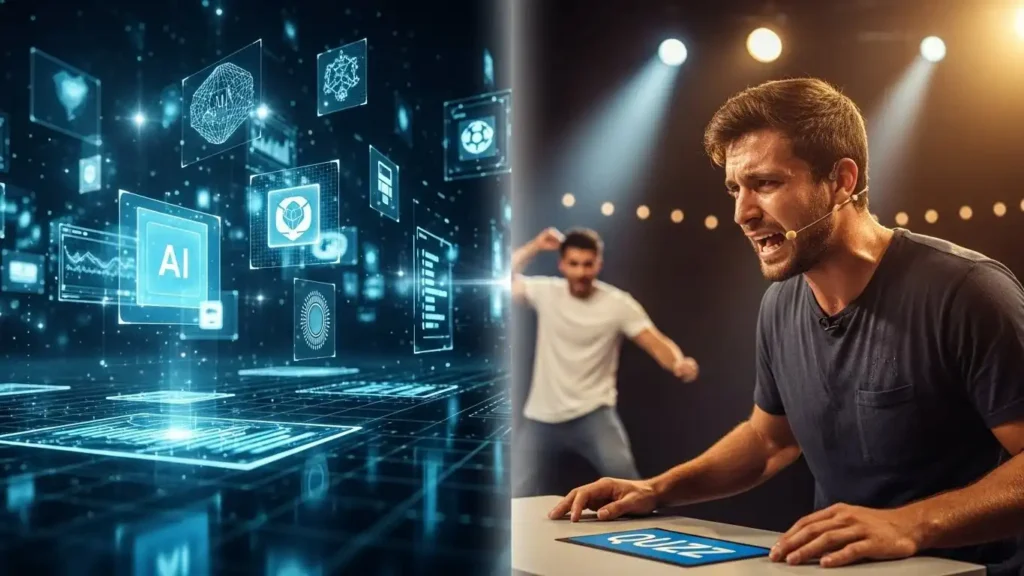
There’s a quiet irony humming beneath the surface of our hyper-digital age: the more seamless, automated, and algorithmically curated our lives become, the more we ache—viscerally—for unfiltered humanity. And we’re willing to pay top dollar for it.
Consider this: during the peak of the 2020 pandemic—when the world shut down, economies trembled, and screens became our only windows to society—live sports didn’t vanish. They mattered more. Leagues scrambled to restart in bio-secure bubbles not just for revenue, but because something primal was missing from our collective psyche. No highlight reel, no AI-generated recap, no VR simulation could replace the raw, messy, unpredictable magic of real people doing things in real time.
That’s why broadcast rights for live sports, talent competitions, and even high-stakes quiz shows continue to skyrocket—even amid recessions, inflation, or global crises. We’re not just paying for entertainment. We’re paying for proof of aliveness.
Technology promised us convenience, connection, and omniscience. And it delivered—brilliantly. But in return, it quietly eroded spontaneity. Our days are now scheduled by calendars that auto-fill, our thoughts mirrored back to us by curated feeds, our decisions nudged by predictive algorithms. Even our triumphs—like finishing a tough assignment or solving a riddle—can be undercut by the nagging whisper: “But did you really do it… or did you just ask AI?”
Enter unscripted, live human performance: the arena where effort can’t be faked, where sweat isn’t rendered in pixels, where a stumble or a surge of brilliance happens for real. A soccer player scoring in stoppage time? A singer hitting a note that cracks with emotion? A contestant on a quiz show locking eyes with the host and saying, “I’m sure”—with nothing but their own mind as backup?
That’s not content. That’s catharsis.
We watch these moments not because we lack knowledge, but because we crave embodiment. In a world where everything can be undone with “Ctrl+Z,” we’re drawn to spaces where consequences are final, effort is visible, and humanity is non-negotiable.
And so, the paradox deepens:
The more we outsource thinking to machines, the more we idolize those who think without them.
The more our lives are smoothed by automation, the more we celebrate friction—the grit, the gasp, the glory of trying and succeeding (or failing) as only humans can.
This isn’t nostalgia. It’s recalibration.
The soaring bids for live, unscripted television aren’t just business—they’re a cultural referendum. They say: Even in a world that can simulate anything, we’ll still pay to witness the one thing we can’t replicate—ourselves, unedited, in real time.
So let the algorithms optimize. Let the AIs write, calculate, and predict.
But when the lights come up and the clock starts ticking—
Give me a human mind.
Give me human hands.
Give me the beautiful, trembling risk of being gloriously, imperfectly human.
Because that’s the only show worth watching.